Sunday — shopping day

One of the side effects of being trapped in the Advisory Board meeting all day Saturday was that I missed calling home when I planned to, and when I got back to my room, there was a message from Diane asking me to call. So I did — and woke Diane up because it was 2:30am in California. I think she was glad I called, but it would have been far better had we been able to get in touch a few hours earlier (or if I had been able to call when I’d originally promised). And I couldn’t call from my room, anyway, because the hotel charges an outrageous fee for international calls — and they also levy a heavy surcharge if you dial the local AT&T access number, so I felt compelled to go to the lobby and use a payphone to avoid being ripped off.

I decided this was not a good situation; the obvious way around this was to get a local mobile phone. I’d spent part of Friday trying to get my UK phone unlocked so I could use a local provider — I even checked the Web for ideas, but all I found were people asking how to get their phones unlocked and no answers. So I decided to buy yet another phone.

I wanted a cheap phone, but one that I could take with me on future trips, so it had to be a dual-band GSM phone. And it had to be unlocked, so I could buy a local SIM in other countries — this turned out not to be a problem; unlike the case in the UK or US, almost all phones sold here are sold outright, and you buy connectivity separately.

I followed a very careful procedure to decide where to shop — I rode the elevator to the ground floor, went out the front door of my hotel, turned right, went to the first phone shop I found, and asked for the cheapest dual-band phone they had. Five minutes later, I was the proud owner of a Mitsubishi Trium — as a properly suspicious consumer, I did make a point of checking out the phone to make sure it worked before I left the shop, and it did.

But when I tried using the phone from my room, I discovered that the phone wasn’t just inexpensive — it was cheap. When I made a call, the phone made funny buzzing noises, as though a circuit board was vibrating; I hadn’t been able to hear the problem in the shop because of the noise there, but now it was obvious.

I was afraid I’d be stuck with the problem — many Hong Kong electronics shops are less than scrupulous (it’s not unknown for a customer to get back to the hotel and find that they’ve bought an empty box). But I decided to go back and complain anyway.

And much to my surprise, the shopkeeper was actually helpful and willing to work with me. At first, he thought the problem might be the quality of the network connection, so he lent me a SIM for a different network and had me make a test call — I couldn’t tell if there was a problem in the shop, so he let me take the phone back to the hotel to try it; it didn’t help.

So then he let me take several different phones back to the hotel to try them — without holding anything as security other than the old phone. I was impressed; I know that I certainly wouldn’t have gotten anything like that service at Fry’s!

Eventually, I bought a much higher-end phone, a Motorola P7689. The phone works nicely and has lots of nice features — I wish I could use it at home, but that would require changing my US mobile service to a GSM provider, which would be a hassle; and GSM service in the US is still pretty spotty.

[Added May 1st: The shop at which I bought the phone was Motech Phone, Shop 22, Ground Floor, Star House, phone +852 2972-2988. I’m still happy with the new phone, by the way.]

After solving the phone problem, I went out with one of my W3C colleagues and wandered through Kowloon for the rest of the day. We even did a little more shopping. At times, we picked random stores just to get into an air-conditioned environment (the weather reminded me of South Florida, and why we no longer live there), but Carl did have some goals in mind, so we spent quite a bit of time in various branches of Yue Hwa Chinese Products.

Then it was back to the hotel and back to work — the W3C Advisory Committee meeting began at 6pm with the New Member orientation (as an Advisory Board member, I felt an obligation to be there), and then the Welcome Dinner. We had a fairly simple dinner, just ten courses (fourteen or more courses are not unheard of!); I ran out of gas after eight courses, and called it a night.
Shabbat Shalom from Hong Kong

I was out quite late Friday night, celebrating; late enough, in fact, that I didn’t want to stay up to edit and annotate the pictures I took yesterday while sightseeing, but I’ve finally gotten caught up, and the travelogue appears below.

After playing tourist all day, I went to Shabbat services at the United Jewish Congregation of Hong Kong. It was a fairly small group because it’s a four-day weekend here, but it was a lively service anyway. And going to services gave me a nice feeling of connectedness, even though I was almost 7000 miles from friends and family.

Oh, and the celebration? After services, several people went to dinner at a nearby Italian restaurant, Pasta e Pizza, and they invited me to join them. The food was good — one of the pizzas used Thai basil and was absolutely delicious — and the company was pleasant.

Shabbat Shalom!

Friday’s travelogue

Friday morning arrived a bit earlier than I wanted — 4am, when I woke up very hungry (the cookie I had for dinner was not enough, I guess). Luckily, the minibar in my room had snacks, not just drinks, so I was able to have a nosh and then got back to sleep until the alarm sounded at 7:30.

It took me a couple of hours to deal with my e-mail and have breakfast, but eventually, I was ready to handle the day’s business — wandering around Hong Kong while adjusting my body clock, so I’d be ready for the W3C Advisory Board meeting on Saturday. I decided to try the walking route through Kowloon suggested in the guidebook I’d picked up (Fodor’s Hong Kong).

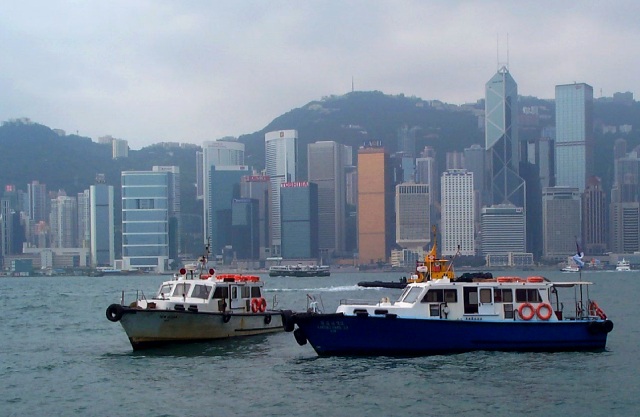
The route starts at the Star Ferry dock, right next to my hotel. The Star Ferry crosses Victoria Harbour, which is a very busy harbour — there are vessels going in all directions almost all the time.

829 hk from waterfront 2.:

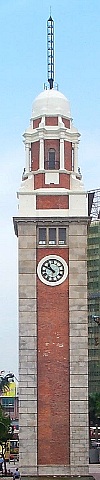
The next stop on the tour was the Victoria Clock Tower, which is the last remaining part of an old railway station.

833 victoria clock tower 4:

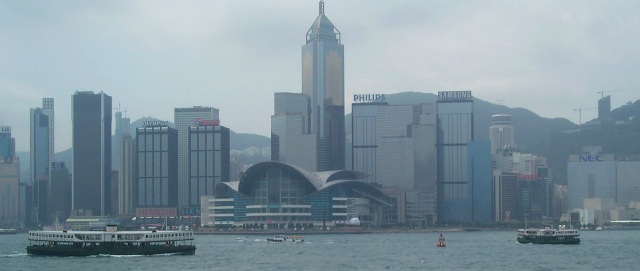
After admiring the Clock Tower, I continued along the waterfront. There’s a two-level walkway; I walked along the upper level and gazed across the harbour to Wanchai, where I’ll be spending next week at WWW10. In particular, I’ll be spending most of the week at the Convention Centre, the large building in the center of the picture below.

835 hk from waterfront 4:

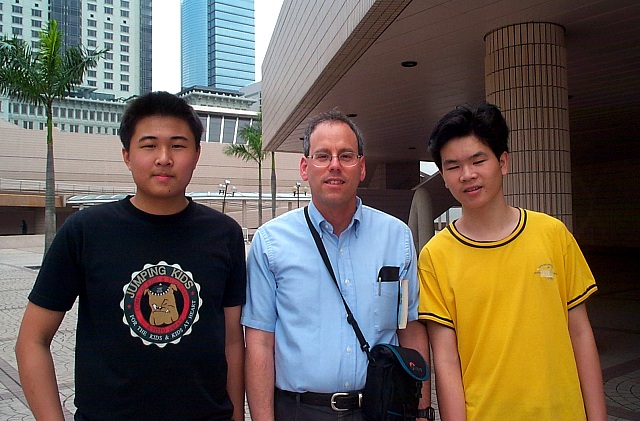
I went back to ground level, to wander around the Cultural Centre. Sudenly, I was set upon by maurauding gangs of English students who had been given the assignment to interview tourists about their experiences in Hong Kong. I’d only been on the ground for 14 hours by this time, so my experiences were pretty scanty, but I was happy to help them out as best as I could — but my price was a picture.

837 with my interrogators:

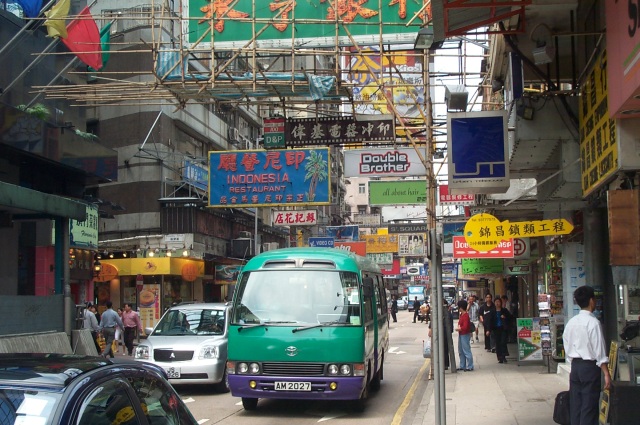
The tour left the waterfront at this point, and so did I. I walked up Chatham Road South, entering a far more commercial area, There are so many shops and businesses that the building fronts don’t have room enough for signs, so they extend over the street:

838 signs on granville:

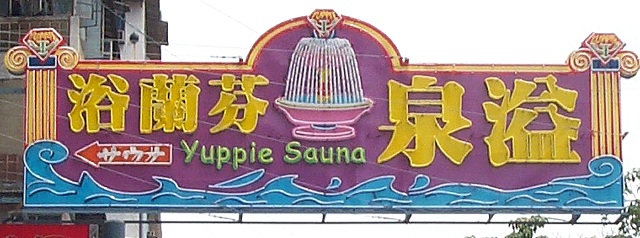
Some of the signs made me wonder:

839 yuppie sauna:

I decided not to find out just what a Yuppie Sauna was; I also declined to take up any of the invitations being thrust into my hands to visit tailor shops — I wouldn’t mind having some shirts made while I’m here, but there’s probably a better way to decide where to have it done than to pick a random shop.

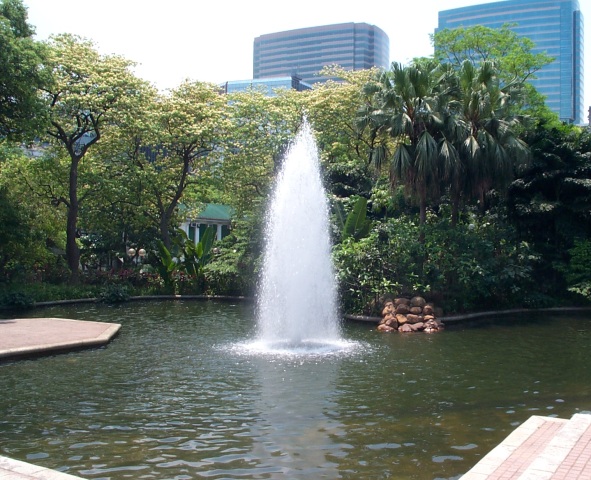
The walking tour continued through commercial areas, over to the Golden Mile on Nathan Road. Eventually, the book directed me to Kowloon Park, which was a wonderful oasis in the midst of the commotion.

842 context of fountain in kowloon park:

Last year, I’d bought a GSM mobile phone while I was in the UK; it was very handy to have there, but Orange doesn’t yet offer international roaming, so I’ve been unable to use it elsewhere. I knew that electronics shops here sold pre-paid SIM cards so that you could have a local Hong Kong number on your phone, so I brought the phone with me to see if I could use one with my phone. But when I tried using a local card, the phone displayed an “Illegal SIM — enter code” message. I hoped that someone would know how to unlock the phone, but I guess I was going to places which were too reputable to know such things, and after trying a few shops, I decided it was time for lunch.

One of the things I’d been asked by the English students was how well I liked Chinese food. I hadn’t had any yet in Hong Kong, and thought I should fix that situation. Fodor’s recommended the Happy Valley Noodle and Congee shop, which was conveniently located across the street from my hotel. I got there towards the end of the lunch rush and had to share a table — fortunately, the guy I shared with didn’t smoke and spoke English, so we had a pleasant conversation. I decided to stick with something familiar and ordered chicken with cashew nuts, and it was excellent.

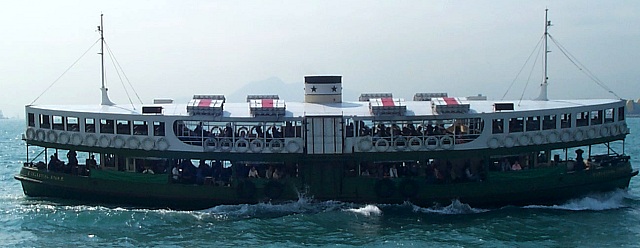
After lunch, I went back to my room for a break. I looked across the harbour and thought it was time to visit Hong Kong proper. I splurged for a first class ticket on the Star Ferry (HK$2.20, about 30 cents US) so I could ride on the top deck (riding down below would have saved HK$0.50, 7 cents US).

847 star ferry from star ferry:

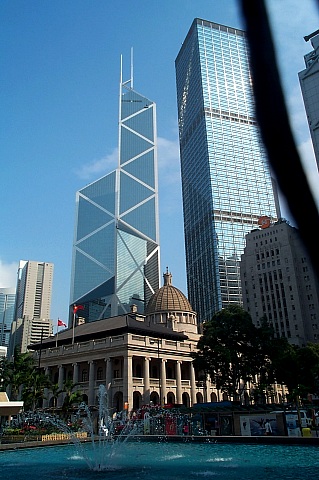
The ferry crossing only took a few minutes, depositing me in the heart of Hong Kong’s financial district, which, like all such, is populated largely by enormous bank buildings, with a few small buildings thrown in for contrast.

848 banks a plenty:

Where there’s money, there are places to spend it. The Landmark is a luxury shopping center, with stores like Christian Dior, Kenzo, and Tiffany. There’s also a Pizza Hut, which struck me as an odd thing to find in such exalted company, but I guess even rich people gotta eat.

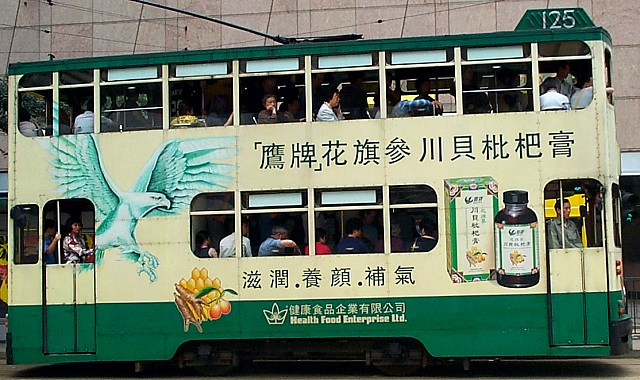
People also have to get around — and in Hong Kong, they use almost every conceivable means. There are subways, taxis, ferries, and trams; like the Star Ferry, the trams are two-level, but I don’t think there’s a price difference for the two levels.

850 tram:

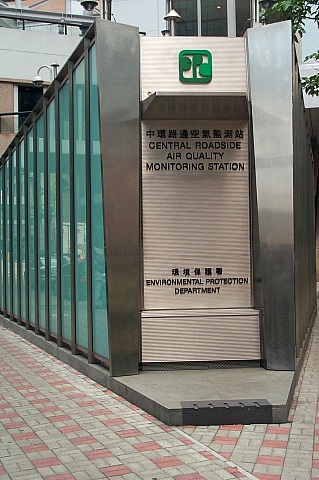
One of the problems with Hong Kong is air pollution — it’s so bad, in fact, that they devote expensive downtown real estate to pollution monitoring stations. This one is right across the street from the Landmark.

851 pollution monitoring station:

And here ends my Friday travelogue; from this point on, I spent my time going to and from Shabbat services.