The little green cup

I’m in Beijing for a meeting of the Technology Council of the IBM Academy of Technology. I had an uneventful, if occasionally very bumpy, flight from SFO-PEK; though I kept my windows closed for most of the flight, I did get a couple of pictures en route. While over Siberia, I got a shot of what seems to be a frozen river:

Siberian River: Siberia looks cold to me! After that, things got boring again outside the window until we were roughly here:
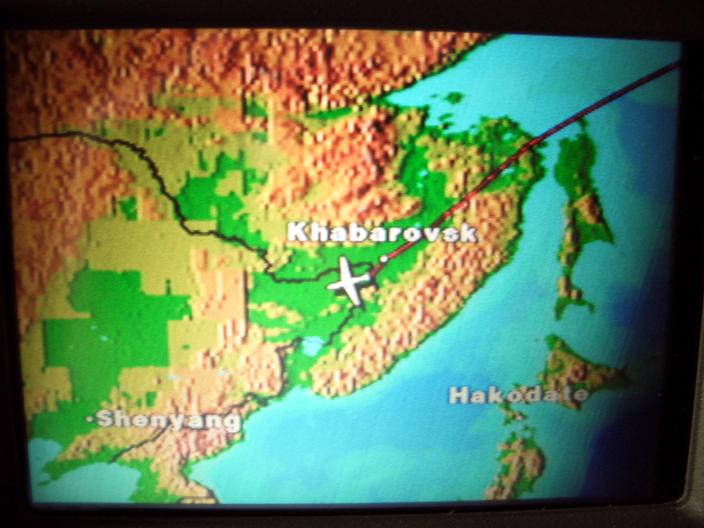
China airmap: when I looked out the window and saw something I couldn’t identify:

China from 38,000 feet: I don't know what these are.  Farms?  Whatever they are, they're enormous! Since we were at about 38,000 feet, the picture covers many square miles — I guess it’s something agricultural, but I have no idea what.

Getting through Immigration and Customs at Beijing Airport took all of 60 seconds. In contrast, I spent an hour in line last year at Narita.

Beijing Airport is also a pretty welcoming place — this was the first thing I saw after leaving customs:
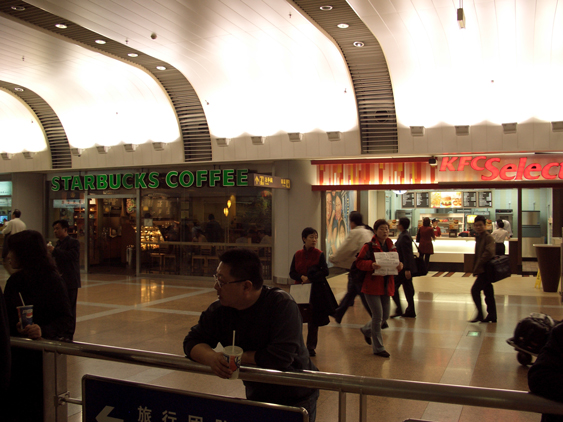
PEK airport scene: though I decided not to indulge.

The trip from the airport to the hotel (Shangri-La Beijing) was easy (the hotel limo helped, I’m sure), and check-in was instantaneous — I was met as soon as I entered the hotel by someone who greeted me by name and took me to my room. I did have to sign the registration slip, but not until I was in the room. I could get used to this….

I arrived on Sunday; the hotel had a special Easter brunch. I wonder what Chairman Mao would have thought.

UMTS — nice where it works

I’ve been looking for a good answer to connectivity while travelling for quite a while. Most of the time, I find myself paying $10/day for high-speed connectivity at my hotel and at T-Mobile hotspots — it’s great, but it’s not available everywhere. And I haven’t quite talked myself into signing up for the $30/month T-Mobile plan because I do want to be able to use wireless at places other than airports and Starbucks (I can’t afford to drink that much coffee!).

So when AT&T Wireless announced their UMTS service last week, I was very interested. 300kb down, 50kb up — not bad. And IBM is willing to pay for the equipment and service, so I gave it a shot.

I got the Novatel Merlin U520 UMTS modem, since I was looking for a strictly-data service. I took it home, installed the software, and was on the air in minutes. And it worked at the advertised speed. It even worked in my office. I was happy (though the software is somewhat goofy!).

Last night, I decided to try an experiment — I set up my laptop on the passenger seat and had it connect to the service as I drove. I intended to start an audio stream and look for dropouts.

But I didn’t get that far. The modem showed “no signal” in the parking lot. That didn’t bother me, because my phone often shows “no signal” there. But I expected the modem to connect as soon as I got into the flats.

It didn’t. I didn’t keep a constant eye on the modem, but I glanced at it from time to time, and the first time I saw connectivity was only a mile or two from my house.

This morning, I used the modem at home, and again, I was happy — especially when we had a brief power outage, and my connection stayed up even though the house router went down (hmmm, maybe I should get a UPS!).

Then I drove to IBM’s Silicon Valley Lab for a meeting. My cellphone had full signal, but the modem showed no signal. So I came up on the building wireless LAN and did some investigation. It turns out that the Merlin U520 is UMTS-only; it doesn’t fall back to GPRS/EDGE, and so it’s useless in a non-UMTS area, which is most of the country. And so it won’t solve my problem of needing connectivity while travelling.

AT&T Wireless offers two UMTS data-capable cellphones which do claim to fall back to EDGE/GPRS data rates. They’re awfully large, but it’s probably worth trying one as an experiment on an upcoming trip. Otherwise, it’s back to Starbucks.